california state tree drawing easy

California Symbols

California Symbols
Amphibian, Animal, Bird, Colors, Dance, Fife and Drum Band, Fish, Flag, Flower, Folk Dance, Fossil, Gemstone, Gold Rush Ghost Town, Grass, Historical Society, Insect, Lichen, Marine Fish, Marine Mammal, Military Museum, Marine Reptile, Mineral & Mineralogical Emblem, Motto, Nicknames, Pet, Poet Laureate, Prehistoric Artifact, Quarter, Reptile, Rock & Lithological Emblem, Seal, Silver Rush Ghost Town, Soil, Song, Tall Ship, Tartan, Theatre, Tree
State Symbols Listing
- State Resources
- » 50 States
- » State Symbols
- » Trees
California State Trees
Redwood
(Taxodiaceae Sequoia sempervirens)
Giant Sequoia
(Taxodiaceae Sequoiadendron giganteum)
Adopted on April 3, 1937. Amended in 1953.
California has designated two distinct species Sequoia, (Taxodiaceae Sequoia sempervirens,) and the Redwood, (Sequoia sempervirens,) as its state trees. Adopted on April 3, 1937. Senate Bill No. 112, adopted in 1937, did not name a particular species but simply referred to the native redwood. This led to some confusion. Exactly what was the native redwood?
In fact, there are two species of redwood that qualify as native to California and, in 1951, California's Attorney General ruled that both species qualified as the official state tree.
In an effort to clarify the law, the California Legislature amended it in 1953. After approval of California Senate Bill No. 1014, the amended law recognized both the Sequoia sempervirens and the Sequoia gigantea as the official state tree.
Redwood | See Sequoia
Redwood
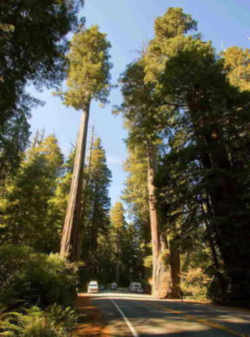
Adopted in 1953.
California has designated two distinct species Sequoia and the Redwood as its state trees.
See Sequoia
The California redwood was designated the official State Tree of California by the State Legislature in 1937. Once common throughout the Northern Hemisphere, redwoods are found only on the Pacific Coast. Many groves and stands of the towering trees are preserved in state and national parks and forests.
Redwood (Sequoia sempervirens,) also called coast redwood and California redwood, is native to the central and northern California coast, a region of moderate to heavy winter rain and summer fog so vital to this tree. It is one of three important North American trees of the family Taxodiaceae. Close relatives are the giant sequoia (Sequoiadendron giganteum) of the Sierra Nevada in California and the baldcypress (Taxodium distichum) of the southeastern states.
The coast redwoods are the tallest trees in the world - one reaching over 360 feet tall grows in the Humboldt Redwoods. One giant sequoia, the General Sherman Tree in Sequoia National Park, is 272 feet high and more than 36 feet in diameter and is widely considered to be the world's largest tree overall.
Identification:
- Leaf: Evergreen, 1/2 to 1 inch long, linear, two-ranked and flattened, yellow-green to green, upper side of needle has sparse stomatal bloom while underside has two distinct bands. Leaves on cone-bearing branches may be scale-like.
- Flower: Monoecious; both males and females are very small and occur near the ends of shoots; males are oblong; females more egg-shaped.
- Fruit: Woody cone, 3/4 to 1 inch long, reddish-brown, basically egg-shaped, mature in one season.
- Twig: Slender, often drooping, initially green and later turning brown.
- Bark: Very thick (up to 1 foot), deeply furrowed with rounded ridges, fibrous, reddish to gray-brown.
- Form: Very large, tall, straight tree (over 300 feet) with a narrow, loose crown.
California Law
The law designating the Redwood as the official California state tree is found in the California Law: Government Code, Title 1, Division 2, Section 422.
GOVERNMENT CODE - GENERAL PROVISIONS.
TITLE 1. GENERAL.
DIVISION 2. STATE SEAL, FLAG, AND EMBLEMS.
SECTION 422.
422. The California redwood (Sequoia sempervirens, Sequoia gigantea) is the official state tree.
Taxonomic Hierarchy: California Redwood
Kingdom: Plantae - Plants
Subkingdom: Tracheobionta - Vascular plants
Superdivision: Spermatophyta - Seed plants
Division: Coniferophyta - Conifers
Class: Pinopsida
Order: Pinales
Family: Cupressaceae - Cypress family
Genus: Sequoia Endl. - redwood
Species: Sequoia sempervirens (Lamb. ex D. Don) Endl. - redwood
Giant Sequoia
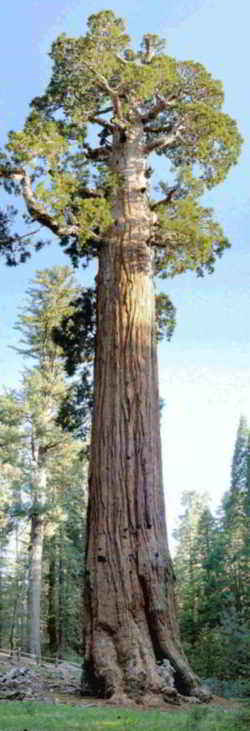
(Taxodiaceae Sequoiadendron giganteum)
Adopted in 1953.
California has designated two distinct species Sequoia and the Redwood as its state trees.
See Redwood
The Giant Sequoia was designated the official State Tree of California by the State Legislature in 1937. Once common throughout the Northern Hemisphere, redwoods are found only on the Pacific Coast. Many groves and stands of the towering trees are preserved in state and national parks and forests.
Since its discovery in the mid-nineteenth century, giant sequoia (Sequoiadendron giganteum), also called sequoia, bigtree, and Sierra redwood, has been noted for its enormous size and age, and its rugged, awe-inspiring beauty. Because the species has broad public appeal and a restricted natural range, most groves of giant sequoia have been accorded protected status. Outside its natural range, both in the United States and in many other countries, giant sequoia is highly regarded as an ornamental and shows promise as a major timber-producing species.
Identification of the Giant Sequoia
- Leaf: Bluish-green; may be scale-like and appressed, or awl-like and spreading, depending on crown position.
- Flower: Monoecious; males egg-shaped and very numerous in spring; females egg-shaped, yellowish.
- Fruit: Oval, woody cone, 1 1/2 to 2 1/2 inches long, brown.
- Twig: Tightly covered in awl-like or scale-like leaves, later turning reddish-brown with scaly bark as the leaves fall off.
- Bark: Very thick (1 to 2 feet) on large trees, deeply furrowed with large rounded ridges, fibrous.
- Form: A massive tree with thick heavy limbs, 250 to 300 feet tall, 10 to 15 feet in diameter.
California Law
The law designating the Giant Sequoia as the official California state tree is found in the California Law: Government Code, Title 1, Division 2, Section 422.
GOVERNMENT CODE - GENERAL PROVISIONS.
TITLE 1. GENERAL.
DIVISION 2. STATE SEAL, FLAG, AND EMBLEMS.
SECTION 422.
422. The California redwood (Sequoia sempervirens, Sequoia gigantea) is the official state tree.
Taxonomic Hierarchy: Giant Sequoia
Kingdom: Plantae - Plants
Subkingdom: Tracheobionta - Vascular plants
Superdivision: Spermatophyta - Seed plants
Division: Coniferophyta - Conifers
Class: Pinopsida
Order: Pinales
Family: Cupressaceae - Cypress family
Genus: Sequoiadendron J. Buchholz - giant sequoia
Species; Sequoiadendron giganteum (Lindl.) J. Buchholz - giant sequoia
State Trees
All of the state trees, except the Hawaii state tree, are native to the state.
Source: https://www.ereferencedesk.com/resources/state-tree/california.html
0 Response to "california state tree drawing easy"
Postar um comentário